
Table of Contents
- Why Drugstore Insoles Fall Short for Heels
- Quick Comparison: Top Alternatives to Dr. Scholl's
- Non-Numbing Sprays vs. Insoles: What Works for High Heel Pain
- How to Make High Heels Comfortable Without Insoles
- Orthotic Insoles for Plantar Fasciitis: When You Need More Than a Spray
- Matching the Solution to Your Shoe and Event
- Pricing and Value: What You Get for Your Money
- Conclusion: Choosing Your Best Alternative
- Frequently Asked Questions
Last Updated: September 20, 2026
Why Drugstore Insoles Fall Short for Heels
Most drugstore insoles were never designed for high heels. They're built for flat shoes with removable footbeds, generous toe boxes, and room to spare. A stiletto has none of that.
Quick Comparison: Top Alternatives to Dr. Scholl's
The best alternatives to Dr. Scholl's for heels fall into three categories: comfort sprays, orthotic insoles, and mechanical fixes like heel grips or ball-of-foot pads. Each solves a different problem.
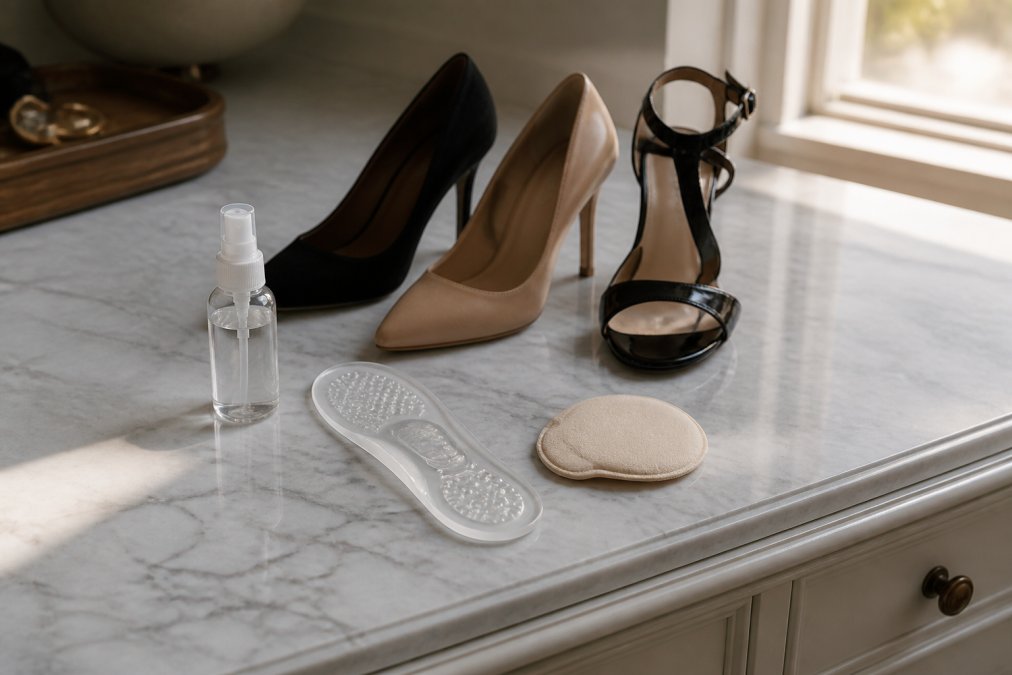
| Option | Best For | Format | Typical Price Range |
|---|---|---|---|
| Comfort spray (non-numbing) | Long events, closed-toe heels, all-day wear | Spray | $20-$49 |
| Orthotic insoles | Plantar fasciitis, flat feet, arch support needs | Insert | Varies by provider |
| Ball-of-foot pads | Forefoot pressure, metatarsal support | Adhesive pad | Low |
| Heel grips | Slipping heels, heel cup stability | Adhesive liner | Low |
| Numbing sprays | Short-term pain masking | Spray | Low |
Non-Numbing Sprays vs. Insoles: What Works for High Heel Pain
A non-numbing comfort spray and an insole solve different problems, and choosing the wrong one is why so many people give up.
How to Make High Heels Comfortable Without Insoles
You can make high heels comfortable without insoles by addressing fit, swelling, and wear time instead of adding padding. Three adjustments cover most of it.
Orthotic Insoles for Plantar Fasciitis: When You Need More Than a Spray
Orthotic insoles for plantar fasciitis are the right call when you have diagnosed heel pain, arch pain that's worse in the morning, or a podiatrist has recommended arch support. A spray helps with swelling. It does not correct a structural issue.
What plantar fasciitis actually is
The plantar fascia is a thick band of tissue running from your heel bone to the base of your toes. It acts like a bowstring, supporting the arch and absorbing force with every step. When overloaded, it develops small tears near the heel attachment, producing the pain.
Why a spray can't fix it
A non-numbing comfort spray works on swelling and surface inflammation, but it doesn't change how your arch loads or reduce tension on the fascia. If the problem is mechanical, the pain returns as soon as the spray wears off, and pushing through can worsen the tear.
What a useful orthotic actually does
A well-built orthotic for plantar fasciitis does three things:
- Supports the arch so the fascia isn't stretched with every step.
- Cups the heel to limit the side-to-side motion that tugs on the attachment point.
- Cushions the heel with a material that holds its shape rather than flattening after a few wears.
Material matters: cheap gel inserts compress and lose their shape quickly, feeling good for a week and useless after a month. Firmer foams and shell-based inserts hold their geometry longer, keeping support consistent.
Over-the-counter vs. custom
Most people with mild to moderate symptoms do fine with a well-chosen over-the-counter orthotic, especially one with a deep heel cup and firm arch. Custom orthotics, made from a mold or scan of your foot, are reserved for cases that haven't responded to off-the-shelf options, significant structural issues, or specific diagnoses a podiatrist has confirmed.
When to see a professional
See a podiatrist or other qualified clinician if:
- Pain persists beyond a few weeks of consistent home care.
- You have numbness, tingling, or burning in the foot.
- The pain follows an injury.
- You have diabetes, circulation problems, or a history of foot ulcers.
- You can't bear weight comfortably.
Where a spray still fits
Most people searching for heel comfort don't have plantar fasciitis. They have foot fatigue, swelling, and forefoot pressure from wearing heels for six hours. For that pattern, a non-numbing comfort spray is the more direct fix, and it pairs well with a thin orthotic when you need both alignment and swelling control.
Still Standing® Spray - Large →
Matching the Solution to Your Shoe and Event
The right fix depends on three variables most guides ignore: the shoe's internal volume, the heel height, and how long you'll be standing. A closed-toe pump behaves nothing like a strappy sandal, and a two-hour ceremony is a different problem from a ten-hour wedding day.
Start with internal volume, not shoe style
Internal volume is the usable space between the footbed and the upper. It determines whether any insert will fit without crowding your toes or lifting your heel out of the shoe.
- Low volume: strappy sandals, ballet flats, pointed-toe pumps, mules. Almost no room for an insert. Spray and fit adjustments only.
- Medium volume: rounded-toe pumps, slingbacks, low block heels, loafers. Room for a thin ball-of-foot pad or a 3/4-length insert that stops before the toes.
- High volume: boots, booties, wedges, platform heels, oxfords. Room for a full-length thin insole or a heel grip plus a pad.
Match the fix to heel height
Heel height changes how your body weight distributes across the foot, which changes what helps.
- Under 2 inches: weight stays closer to the heel and midfoot. Arch support and heel-cup stability matter more than forefoot cushioning.
- 2 to 3 inches: weight shifts forward onto the ball of the foot. Ball-of-foot pads and forefoot cushioning start to earn their place.
- Over 3 inches: most of your body weight lands on the metatarsal heads. Forefoot pressure, swelling, and toe crowding become the dominant problems, and full-length inserts usually stop fitting.
Match the fix to event length
- Two hours or less: a single pre-event application of a non-numbing comfort spray is usually enough. Skip the inserts.
- Two to six hours: spray before you leave, plus a thin ball-of-foot pad if the forefoot aches. Keep a mini bottle for reapplication.
- Six hours or more: spray before the event, reapply at the midpoint, and bring a lower heel or flats for the final stretch. This is the wedding-day and all-day-conference scenario.
Shoe-by-shoe breakdown
- Closed-toe pumps: comfort spray plus a thin ball-of-foot pad if the forefoot aches. Skip full-length inserts unless the pump is medium volume.
- Strappy sandals: spray only. Insoles rarely fit without showing, and adhesive pads can pull at delicate straps.
- Pointed-toe heels: spray only, plus a toe spacer if you have overlapping toes. The taper leaves no room for anything else.
- Boots and booties: spray plus a heel grip if the heel slips, and a thin full-length insole if the boot has removable footbeds.
- Wedges and platforms: spray plus a ball-of-foot pad. The wider platform gives you more room than a stiletto, but the forefoot still takes the load.
- Wedding-day heels: the Comfort Set, so you can reapply between the ceremony and the reception without carrying a full-size bottle.
- Travel or work days: the Mini fits in a clutch or pocket and is TSA-friendly.
The sizing-up mistake
A common workaround is buying a half size up to make room for an insert, but this changes how the shoe fits everywhere and usually trades toe crowding for heel slippage. If you need arch support in a low-volume heel, look for a thin, trim-to-fit insole designed specifically for heels rather than a full-length one built for sneakers. If the shoe is genuinely low volume, no insert will fit well, and the spray-plus-fit-adjustment route is the honest answer.

Pricing and Value: What You Get for Your Money
Price matters most when you're buying something you'll use once. Here's how the options stack up.
Conclusion: Choosing Your Best Alternative
The best dr scholls alternatives for high heels come down to what's causing your discomfort. If it's swelling and fatigue, a non-numbing comfort spray addresses the root cause without deadening sensation. If it's a structural issue, an orthotic is the right tool.
Frequently Asked Questions
What are the best professional-grade alternatives to drugstore insoles?
Professional-grade alternatives often include custom-molded orthotics or high-quality over-the-counter options that focus on specific needs like arch support or metatarsal support. For high heels, non-numbing comfort sprays like Still Standing® are a popular alternative. They use cooling menthol and plant-derived anti-inflammatory ingredients to reduce swelling and discomfort without deadening sensation, which can help prevent dangerous falls.
Are there non-numbing alternatives for high heel pain relief?
Yes, non-numbing alternatives focus on reducing inflammation and cooling the foot rather than blocking pain signals. Still Standing® Spray is a non-numbing option made with menthol and plant-derived ingredients. It is designed to support comfort without deadening sensation, allowing you to feel the ground and maintain stability. This approach helps address the root causes of discomfort like swelling, rather than just masking the pain.
How do premium orthotic brands compare to mass-market inserts?
Premium orthotic brands typically use higher-quality, durable materials and offer more specific structural support, such as a deeper heel cup or firmer arch support. Mass-market inserts are often made with less dense foam that flattens quickly. For high heels, premium options may include slim, trim-to-fit designs that provide better stability and pressure distribution without crowding the shoe.
What should I look for in an insole for plantar fasciitis?
For plantar fasciitis, look for an insole with firm arch support and a deep heel cup to stabilize the foot and reduce strain on the plantar fascia. Cushioning is also important for shock absorption. However, if you wear high heels, a full-length orthotic may not fit. In that case, a metatarsal pad or a comfort spray that reduces swelling can be a practical alternative for managing pain during events.
Are spray-on comfort solutions effective for long events?
Spray-on comfort solutions can be effective for long events, especially those designed to reduce swelling and provide a cooling sensation. Still Standing® Spray is formulated to help you stay comfortable in high heels for hours. For best results, apply it before the event and keep the mini size for reapplication. It is TSA-friendly and portable, making it easy to refresh your comfort throughout the day or night.