
Table of Contents
- FootRescue vs Better Heel Pain Solutions: A 2026 Comparison
- Quick Comparison Table: FootRescue vs Alternatives
- How to Wear High Heels Without Pain
- Best High Heel Pain Relief: Sprays vs Inserts vs Gels
- Material Degradation and Cost-Per-Wear
- Still Standing® Spray: Product Line and Pricing
- Conclusion
- Frequently Asked Questions
Last Updated: September 16, 2026
FootRescue vs Better Heel Pain Solutions: A 2026 Comparison
If you have ever kicked off your heels at a wedding reception and limped to the car barefoot, you already know that foot pain is not a minor inconvenience. It is the thing that ends your night early. This comparison from Still Standing® Spray examines FootRescue against other heel pain solutions, from inserts and gels to non-numbing sprays, so you can decide what actually belongs in your clutch before the next big event.

How We Evaluated
We scored each option on five criteria: how quickly it works, whether it preserves sensation and balance, how well it fits inside a real shoe, how long the effect lasts, and cost per wear. We weighted fit and safety highest, because a product that makes you wobble is worse than no product at all.
We also looked at what happens over time.
Quick Comparison Table: FootRescue vs Alternatives
| Solution Type | Onset Speed | Preserves Sensation | Shoe Fit Impact | Cost Per Wear | Best For |
|---|---|---|---|---|---|
| Non-numbing comfort spray | Fast | Yes | None | Low | All-day events, weddings |
| Numbing spray | Fast | No | None | Low | Short wear, not balance-critical |
| Gel inserts | Moderate | Yes | Can crowd the toe box | Low | Flats, roomy shoes |
| Adhesive heel cushions | Moderate | Yes | Minimal | Low | Blister prevention only |
| Compression socks | Slow | Yes | Bulky in heels | Low | Recovery, not wear |
The pattern is clear: the options that fit invisibly and preserve your balance tend to be the ones people actually keep using.
How to Wear High Heels Without Pain
The short answer is that you prepare the foot before you put the shoe on, not after the ache sets in. Cooling the foot, reducing friction at the heel and ball, and choosing a shoe that matches your arch all matter more than any single product.
A practical routine looks like this:
- Apply a cooling comfort spray before your first step, not midway through the night
- Break in new heels for short indoor sessions before the event
- Rotate heel heights across the week so the same pressure points do not take repeated load
- Keep a mini bottle in your clutch for a mid-event reapplication
- Take a seated break every couple of hours to offload the forefoot
Fit and Shoe Compatibility
Fit decides whether any product works. A spray disappears into the shoe with no volume change, which is why it suits pointed toes and strappy sandals where an insert simply will not sit flat. Gel inserts need vertical room, so they work in boots and roomy pumps but crowd a narrow stiletto.
Best High Heel Pain Relief: Sprays vs Inserts vs Gels
Sprays win for events where you cannot change shoes and cannot afford to lose your balance. Inserts win for shoes with room to spare. Gels sit in the middle, useful for blister prevention but limited for deep discomfort.
Material Degradation and Cost-Per-Wear
Most comparison guides treat durability as a footnote. It is actually the variable that decides whether you are buying relief or renting it. Here is what happens inside each format, why it fails, and how to run the math yourself. Structural integrity remains the primary indicator of long-term utility, a principle that extends beyond simple heel inserts to the broader category of orthopedic braces for recovery.
Why gel and foam inserts break down
Cushioning materials fail through two distinct mechanisms, and they fail at different rates.
- Compression set. Every time you load a foam or gel insert, the cell walls deform. Under repeated load, they stop springing back. The material takes a permanent set, it stays flattened. This is why a gel insert that felt plush in week one feels like a thin sheet by month three. Heat accelerates it: a car interior on a summer day can push a foam insert well past the temperature where its polymer structure relaxes and stops recovering.
- Shear forces. Your foot does not just press down on an insert, it slides and twists across it with every step. That lateral shear tears at the bond between the cushioning layer and the top cloth, and it abrades the surface. This is the mechanism behind the familiar pattern of an insert that still has thickness in the heel but has gone slick and flat under the ball of the foot.
Why sealed liquids behave differently
A sealed spray bottle has no open-cell foam to collapse and no bonded layers to shear apart. The active ingredients sit in solution inside a container that is not under load. As long as the cap is on and the bottle is stored out of direct sun, the contents do not take a compression set, because nothing is compressing them.
How to calculate cost per wear
The number that matters is not sticker price. It is price divided by the number of wears you actually get before the product stops working.
Run it like this:
- Note the purchase price.
- Divide.
A durability comparison by format
| Format | Primary failure mode | Typical performance curve | Cost-per-wear behavior |
|---|---|---|---|
| Gel or foam insert | Compression set, then shear delamination | High at first, declines steadily | Rises over time as wears accumulate |
| Adhesive heel cushion | Adhesive failure, then compression set | Moderate, then sudden | Rises sharply once the adhesive gives |
| Compression sock | Elastic fatigue (gradual loss of graduated pressure) | Gradual decline | Rises slowly |
| Sealed comfort spray | None under normal storage | Flat, consistent across the bottle | Stable across the life of the bottle |
Still Standing® Spray: Product Line and Pricing
Still Standing® Spray is a non-numbing, cooling menthol foot comfort spray built for high heels and stilettos. It combines cooling menthol with plant-derived anti-inflammatory ingredients to help reduce the swelling and discomfort that lead to stiletto suffering. It is paraben-free, cruelty-free, and made without numbing agents, so it supports comfort without deadening sensation.

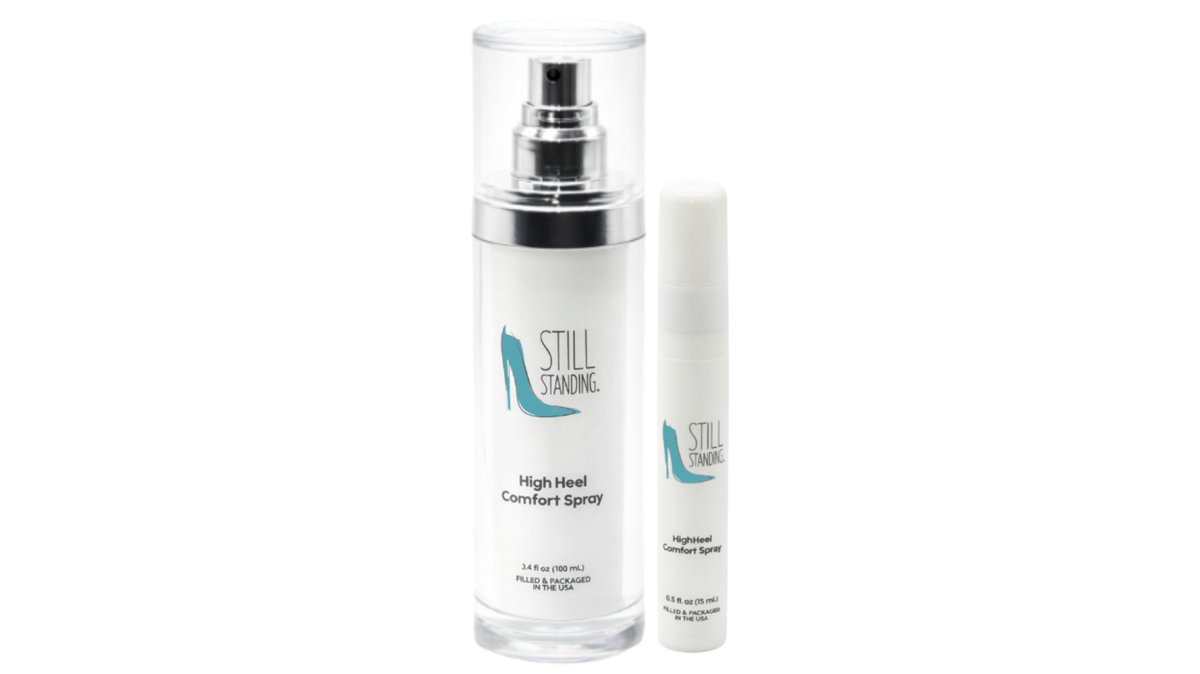
The line covers four options:
- Still Standing® Spray - Large: $37.99, 3.4 fl oz, the primary first application for even coverage and longest-lasting comfort
- Still Standing® Spray Comfort Set: $48.99, large bottle plus mini for reapplication through the day or night
- Still Standing® Spray - Mini: $20.00, 0.5 fl oz, sized for a clutch or pocket
- Still Standing® Spray - Mini Set: $34.00, a set of minis for yourself or to gift to your wedding party
Which Still Standing® Product Fits Your Routine?
Match the format to how often you wear heels and how long you are out. One bottle does not suit every schedule.

| Your Situation | Recommended Product | Why |
|---|---|---|
| One big event, occasional wear | Spray - Large ($37.99) | Full coverage for a single long day |
| All-day wedding, multiple reapplications | Comfort Set ($48.99) | Large for the morning, mini for the reception |
| Daily office wear, purse carry | Spray - Mini ($20.00) | Fits a small bag, reapplies on the go |
| Bridal party gifting | Mini Set ($34.00) | Share with bridesmaids or your mother of the bride |
Conclusion
The gap between a comfortable night and a painful one usually comes down to preparation and the right format, not willpower. If you want a non-numbing option that fits invisibly inside any heel and supports comfort without dulling your balance, Still Standing® Spray is the pick we stand behind, backed by its plant-derived anti-inflammatory formula, TSA-friendly sizes, and 30-day money-back guarantee.
Frequently Asked Questions
Which is better, gel or foam insoles?
Gel insoles provide more cushioning and shock absorption, which helps with heel strike and impact attenuation during high-impact activities. Foam insoles are lighter and often more affordable, but they tend to compress faster with daily wear. For high heels, gel inserts can help with pressure distribution, but they may alter fit and cause slippage. Neither addresses swelling the way a non-numbing spray like Still Standing® does. The best choice depends on your shoe type, activity level, and whether you need cushioning or structural support.
Are topical sprays better than inserts for heel pain?
It depends on the cause of your pain. Inserts add cushioning and arch support, which helps with biomechanics and pronation issues. Sprays like Still Standing® deliver cooling menthol and plant-derived anti-inflammatory ingredients to reduce swelling and discomfort without numbing. For high heel wearers, sprays have a key advantage: they do not change shoe fit, so you avoid the tightness and slippage that inserts can cause. Many people use both, but for stiletto-specific pain, a spray is often the more practical first line of defense.
How does Still Standing® Spray compare to traditional shoe inserts?
Traditional inserts sit inside the shoe and add a physical layer of cushioning. They can help with arch support and shock absorption, but they often make high heels too tight and can shift during wear. Still Standing® Spray is applied directly to the foot before putting on shoes. It uses cooling menthol and plant-derived anti-inflammatory ingredients to reduce swelling and discomfort, and it is made without numbing agents. It does not alter fit, is TSA-friendly, and works with any shoe style.
What should I look for in a high heel pain relief product?
Look for three things: whether it changes shoe fit, how long the effect lasts, and whether it addresses swelling or just masks pain. Numbing products can be dangerous because they deaden sensation, which may lead to falls or injuries. A non-numbing formula like Still Standing® Spray supports comfort while keeping you aware of your footing. Also check for portability, TSA-friendly sizing if you travel, and a satisfaction guarantee. Cost-per-wear matters too: a $37.99 bottle that lasts months often beats repeated $10 insert purchases.
Can shoe inserts cause more pain if not fitted correctly?
Yes. Inserts that are too thick or too rigid can create pressure points, restrict toe movement, and cause blisters or metatarsal pain. In high heels, a poorly fitted insert can push your foot upward, leading to heel slippage and increased shear forces. If you try inserts, start with thin options and test them for short wear periods. If you feel pinching or numbness, remove them. For many high heel wearers, a spray avoids these fitment risks entirely because it does not change the inside volume of the shoe.
Heel pain does not have to decide when your night ends. Still Standing® Spray offers a non-numbing, cooling menthol formula that helps reduce swelling and discomfort, a portable size for your clutch, and a 30-day money-back guarantee so you can test it risk-free. Get started with Still Standing® Spray and stay comfortable in your favorite heels from the first step to the last dance.